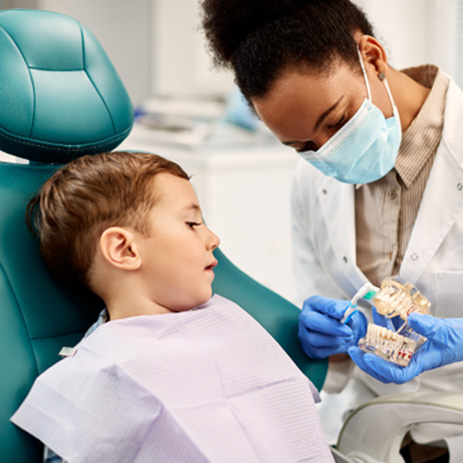
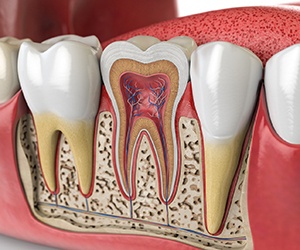
To put it simply, even baby teeth can become infected. You might think you can simply have them removed to solve the problem, but doing so too early could affect the way the permanent teeth erupt, lead to a crooked smile, and result in painful bite issues. That’s why we encourage parents to call our team at Worcester Endodontics! If we find signs of an infection, we can eliminate it before severe damage is done with endodontics for children.
Why Choose Worcester Endodontics for Endodontics for Children?
Gentle, Board-Certified Endodontic Experts
Carefully Customized Dental Crowns
Child-Friendly Sedation Solutions
Does Your Child Need Endodontic Treatment?
Usually, there are symptoms that come with badly decayed and infected teeth, like:
Persistent sensitivity
Pain when biting down
Swollen or bleeding gums
Dark discoloration on the tooth in question
Of course, there are some cases when there aren’t any warning signs too. That’s why it’s so important to schedule a dental checkup every six months! These routine visits ensure that we catch decay, infections, and other common oral health problems as early as possible.
The Pulpectomy Process
Once the infection has reached the root of the tooth, the entire pulp is compromised. It will need to be removed completely for the sake of your child’s health. The tooth itself will be numbed for the procedure, ensuring that your little one won’t experience any pain during the treatment process. Then, the inside of the tooth will be cleaned and disinfected before we fill it with biocompatible dental cement and place a crown for its protection.
The Pulpotomy Process
Sometimes the decay or trauma of the pulp has not spread very far and is still limited to the crown of the tooth. In these cases, a pulpotomy can be performed to protect the tooth. Only the infected part of the pulp in the crown is taken out; the portion living in the roots of the tooth is left intact so it can continue providing nourishment. Any empty space will still be filled with dental cement, however.
The Benefits of Getting a Root Canal for Kids
There are several benefits that come with root canals, including the fact that they are virtually painless, have an extremely high success rate, and can effectively eliminate the infection, saving your child’s tooth in the process.
It’s also worth noting that, after any kind of endodontic treatment, your child’s tooth will most likely be in a weakened state. Fortunately, we can give your child a dental crown so they can continue using the treated tooth to chew all of their favorite foods without having to worry about damaging them further.
If you are interested in learning more about endodontics for children, don’t hesitate to give us a call! We’d be happy to answer any questions you have, especially about something as important as your little one’s oral health.
Understanding the Cost of Root Canals for Kids
If your child has been dealing with a relentless toothache, chances are, they might need to undergo a pulpectomy or pulpotomy—commonly referred to as root canal treatment for kids. Though this might sound alarming, you can trust that this form of treatment is designed to save the tooth and protect their future smile. However, it might not be the outcome that has you anxious, but rather, the cost of care. At our Worcester office, we believe in transparency, meaning we’ll review all relevant cost factors, how dental insurance plays a role, and what your financing options are. To learn more, just keep reading or contact our front desk team!
Factors That Can Affect Root Canal Cost
The cost of a root canal varies based on several factors, including the location and the type of tooth, as well as the severity of the infection. Molars, or the back teeth, have more complex anatomies with more roots and canals to clean, making them more expensive to treat than front teeth. Baby teeth are also generally easier to treat, often resulting in lower costs compared to adult teeth. An advanced infection might also require more extensive cleaning or multiple visits, which can also increase costs. Our team will carefully review all of these price factors with you so that you fully understand how every dollar is being spent on your child’s smile.
Is It Cheaper to Extract My Child’s Tooth?
You might be thinking that it’ll simply be cheaper to have your child’s tooth extracted, rather than undergoing a root canal. Although this is sometimes true concerning the initial price tag, having a tooth extracted comes with many other future costs that you might not be expecting. For example, if it’s a permanent tooth in question, it will need to be replaced in order to prevent future complications for your child’s smile—and this can greatly add to the total cost of care. On the other hand, root canal treatment is typically a one-time cost that provides lasting oral health benefits for your child.
Does Dental Insurance Cover Root Canal Treatment?
You’ll be happy to hear that many dental insurance plans cover the cost of a root canal for kids if it is deemed medically necessary. It’s often classified as a restorative service, meaning that you can expect at least partial coverage that typically ranges from 50% to 80%, assuming you’ve met your plan’s deductible and completed any waiting periods. We understand that dental insurance can be confusing, and our team is more than happy to review the specifics of your plan with you to ensure you’re making the most of your coverage. We’re also able to file claims on your behalf; just let us know how we can help!
Other Options for Making Root Canal Treatment More Affordable
If you don’t have dental insurance coverage for your family, you might be worried about affording your child’s root canal treatment. However, there are other options for easing your financial burden. In addition to being an insurance-friendly practice, we are also partnered with CareCredit, a trusted third-party financer that provides flexible payment options with little to no interest. All you need to do is apply—and if you need any assistance with this, our team is happy to
Endodontics for Children FAQs
Does Endodontic Treatment Hurt?
Hands down, one of the most-asked questions from parents and their kids is, “Does it hurt?” If that’s something you and your child have been worrying about, we have good news: the first step is always numbing the area. That way, they don’t feel any pain or discomfort as we work to eliminate the infection and restore their healthy smile.
Tip: If your child is feeling particularly nervous, anxious, or worried, ask us about sedation dentistry!
Can Endodontic Treatment Be Prevented?
Oftentimes, yes! The key is implementing healthy habits into your child’s daily routine, like brushing for two full minutes each morning and night, flossing consistently, and eating healthy, well-balanced meals. It’s also of the utmost importance that you bring them to our office for a checkup and cleaning every six months. While the checkup helps us catch cavities in the early stages, the cleanings ensure we can clean the hard-to-reach areas of their mouth as well as remove plaque and tartar!
Can My Child Eat Before Endodontic Treatment?
If your child is being sedated for the procedure, then we will likely ask them to fast beforehand (this will help prevent them from feeling nauseous). If they aren’t, then they can eat a healthy, well-balanced meal beforehand. Just make sure that they brush and floss their teeth afterward!
Why Does My Child Need Endodontic Treatment If Their Tooth Doesn’t Hurt?
This is a very common question regarding root canals for kids. The answer is simple: an excruciating toothache isn’t the only symptom of a badly decayed or damaged tooth. During the exam, our Worcester dental team will also look for dark discoloration, inflammation, and other warning signs of trouble. If we believe that endodontic treatment is warranted, we will let you know and share why the procedure is necessary.
Does Endodontic Treatment Make You Sick?
Did you hear that endodontic treatment can lead to illness? If so, it’s important to know where this myth stems from. Back in the 1920s, a dentist named Dr. Weston Price claimed that it was better to have a tooth extracted since root canals didn’t remove all of the bacteria. However, his research was poorly designed, and his findings have been disproven on several occasions. Today, there isn’t any scientific evidence to support his claim.
As always, if you have any questions for us about the procedure or you want to fact-check something you’ve heard, don’t hesitate to give us a call! We’re here to answer questions, ease concerns, and provide further insight so our patients and their families can feel completely confident moving forward with the recommended treatment plan.