
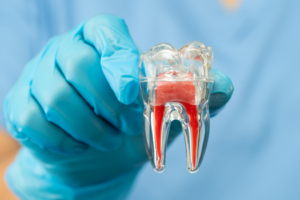
If you’ve been told that you’re going to need a root canal, you might feel a knot form in your stomach. However, this procedure has garnered a very unfair reputation—not only are they quite straightforward and far less painful than how they’re portrayed, but they also give an infected tooth a real chance at remaining part of your smile. That said, it’s very common for patients who undergo root canals to receive a dental crown afterward; here’s why this is.
What Happens During a Root Canal?
Inside every tooth is a soft center filled with nerves and blood vessels, called the pulp. When bacteria from deep decay, a crack in the tooth, or trauma invade this pulp, infection sets in. Left untreated, that infection can spread to the surrounding bone and cause serious complications.
Root canals are designed to remove this infected, inflamed pulp tissue. Additionally, the root canals found within the tooth are cleaned, reshaped, and sealed to prevent reinfection. The tooth is also filled with a special biocompatible material to help it retain its shape. Rest assured, a patient’s mouth is fully numbed for this process. Often, a dental crown is also placed over the tooth to protect its structure and ensure it looks and functions like normal.
Why Dental Crowns are the Go-To Restoration Following a Root Canal
Even though a root canal saves your tooth and prevents the need for extraction, it does permanently change it. When pulp tissue is removed, the tooth loses its internal nerves and blood supply, meaning that it’s more vulnerable to structural damage. Plus, most teeth that end up needing root canals have already been substantially weakened due to decay or physical trauma. This means that in order for a root canal to have lasting benefits, the tooth itself needs a little extra help.
In some cases, a dental filling might be sufficient—but in most instances, a crown can do the trick. A dental crown is a cap that covers the entire visible portion of the tooth down to the gumline. It does something a filling simply cannot: it protects the remaining tooth structure, distributing biting forces evenly and dramatically reducing the risk of additional damage.
The bottom line is, while a root canal is the process that actually saves your tooth, a dental crown is the finishing touch that ensures its lasting protection for years to come.
About the Practice
Under the leadership of Dr. Karyn Stern, Dr. Niusha Nikkholgh, and Dr. Marta Rafla, our team here at Worcester Endodontics serves patients in Worcester and the surrounding area. We offer a wide range of endodontic services, including root canal therapy performed by our expert team. If you have a tooth that’s in trouble, we can ensure that it’s made to be healthy and whole once more for the benefit of your smile. To learn more or to schedule an appointment, you can contact us online or by phone for assistance. Telephone: (508) 731-8564.